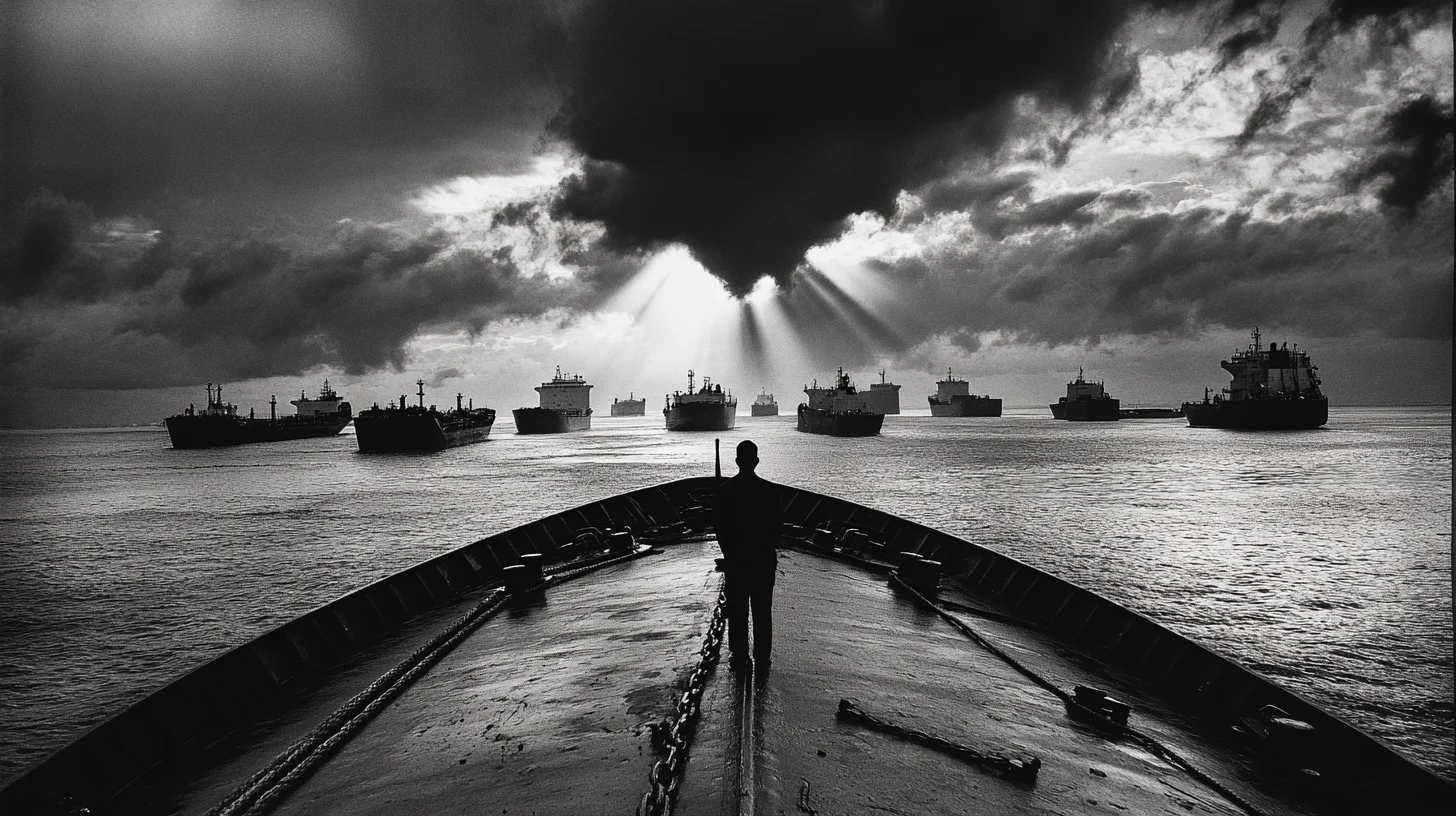
You Have A Fuel Problem.
#Business #Engineering #RiskManagement
This article was written by Tim Chadwick and published by MoneyMarketing on 30 March 2026
Somewhere Near Dubai
The Strait of Hormuz, until recently, occupied the same mental real estate for most South Africans as your IT guys 2 hour sermon on cloud migration versus on premise storage. It was a background hum. An annoying hum, I might add. Technically important, sure. Tedious, definitely. But not really your problem. Well, the hum just got a lot louder.
It is now your problem. And mine.
The Hormuz sits between Oman and Iran and has efficiently moved a fifth of the world’s daily oil supply for several decades. It is not, for what it is worth, anywhere near Dubai. I know, the title of this piece is geographically a bit of a stretch. But geography, in the current situation, is the least of our concerns.
South Africa is already feeling the heat. Diesel signs at some fuel stations across the Western Cape, the Northern Cape and Gauteng are showing nothing. Just like the fuel attendants. A blank, empty plastic stare. And that is also what is in the tank. The industry calls it “controlled allocation.” In South Africa, we should call it fuel load shedding. It is what rationing looks like when it has been through a corporate comms committee wash.
But, fear not, six fuel vessels are on their way from India and West Africa to rescue SA.
Supply is being managed. I believe this completely, in the same way I believed, for roughly four years, that load shedding was a bridge measure, which it was of course, in the sense that it bridged 2019 to 2023 without the lights coming on.
Wednesday, 2am. Nine Degrees. And Rising.
My client Pietie farms apples in the Elgin Valley.
He is meticulous. He reads his policy schedule the way a sensible person reads a Spur menu, before ordering, not after, when the waiter has disappeared to sing happy birthday to Chico the clown.
He phoned me at half past seven on Wednesday morning. His packhouse generator had run dry at 2am. The diesel allocation had not arrived. Forty tons of export were sitting at nine degrees and climbing toward the temperature that ends careers in the apple business. He wanted to know what his Deterioration of Stock cover would do for him. Before I had coffee. Technically, in South Africa, this is a human rights issue.
Deterioration of Stock cover generally responds when an insured event causes temperature loss. Like equipment breakdown. Like power failure from a covered accidental cause.
“The diesel ran out” is not on the list.
This is not a gap in the cover. It is a crime scene line. Insurance typically does not respond to foreseeable supply disruptions. It would be a vastly more expensive product if it did, roughly as affordable as a Woolies trolley on a Saturday afternoon, with teenagers who have opinions about Levi’s.
It is, however, the kind of line that introduces itself at 2am, at nine degrees and climbing, which is not the ideal temperature for discovering new things about your policy. Pietie had read his policy correctly. And he found his accurate understanding of his own uninsured financial position vaguely depressing.
Then, at 6am, the diesel arrived.
Power was restored. The generator restarted. The story turns, in the way good stories sometimes do, toward the slightly less catastrophic. On restart, the fuel pump, having spent several hours doing nothing, followed by a hard cold start under duress, seized. Klaar. Finished. Kaput.
Sudden. Unforeseen. Mechanical failure.
Covered. Probably, all things being equal.
Pietie lost twenty one tons, not forty. His claim is in process. His risk advisor filed it at 5:30am, after coffee. Twenty one tons of apples lost is not a triumphant outcome. However, at six degrees on a Thursday in Elgin, it probably passes as a reasonable outcome. And so say I.
The Structural Problem Behind the Forecourt Sign
South Africa imports approximately 75% of its refined diesel.
From India. From the UAE. On tankers that come through the Hormuz and other routes and arrive, when everything is working, with the reassuring reliability of a system nobody thinks about until it stops working. Like the office aircon that works in winter and which invariably has a prior engagement in summer.
The domestic refining capacity that used to carry some of this load has found a shallow grave. SAPREF in Durban, 180,000 barrels a day, roughly 35% of domestic refining capacity when it was running. Closed in 2022. Rehabilitation plans exist and are documented. The refinery does not yet have output. It turns out the gap between intending to run a refinery and running one is wider than it appears from the intentions side, which should surprise no one who has ever watched a DIY home renovation project or the Proteas in a knock out World Cup game.
Meanwhile, Transnet’s 3,800 kilometre petroleum pipeline, the one that moves fuel from the coast to the interior and receives no public affection, until it is the most important infrastructure in your week, is being actively attended to by organised criminal syndicates. Heavily armed. Better coordinated than several government departments one could name, but won’t, out of respect for the ongoing process of improvement. Fuel theft. Vandalism. Localised shortages that appear at forecourts without warning and disappear from the news with suspicious speed.
And then there is the reserve position. South Africa holds approximately fourteen days of strategic fuel at Saldanha Bay. The International Energy Agency’s global benchmark. A number that was settled on after the 1973 oil embargo taught the world the same expensive lesson simultaneously, is, wait for it. Ninety days. The gap between fourteen and ninety is not an abstraction. It is the space between a supply shock and Pietie at 2am.
The other seventy six days have not gone AWOL. They are present in the form of reports, action items, meetings and further meetings about the action items from the first meeting. Richly documented. Fourteen days, however, remains fourteen days regardless of how many meetings have convened around the number. The meetings are not, strictly speaking, refining anything. And guess what, beige is the meetings favourite colour.
The Neighbour with the Cellar
So, here is the crude irony. Pun intended. Delivered without embellishment, since it needs none.
Africa pumps crude oil in volumes that should, in theory, make refined fuel a domestic matter of passing irrelevance. Nigeria. Angola. Algeria. The tankers leave full. They sail to refineries in Europe, India and the Gulf. The finished product comes back at a price that includes the refiner’s margin, the shipping, the handling and whatever the current global situation has recently added to the invoice. Africa exports the ingredient and imports the recipe, with the cheerful consistency of a farmer who grows his own grapes, hands them to a neighbour with a cellar and buys the wine back at restaurant prices.
The neighbour has an excellent cellar and no intention of changing the arrangement.
Africa has the crude. Has had it for decades. The refinery to process it locally remains a feasibility study. Popular belief is that these findings will be shared now-now. FYI, now-now, is a SA technical term for do not hold your breath, boet. Time for a commercial break, sportslovers.
The Fleet. The Commute. The Arithmetic.
For any business running a vehicle fleet or a large commuting workforce, the current diesel situation is not arriving as a surprise. It is arriving as frightening arithmetic.
In 2020, South Africa accidentally ran one of the more effective national fuel demand reduction experiments of the century, thanks to big disease with a little name. COVID (kudos to Symbol, the artist formerly known as Prince). The commuter fleet stopped. The N1 at 7:45am on a Tuesday looked like a country that had made extraordinary decisions about urban planning. The office economy kept functioning and discovered that a remarkable number of its most firmly held beliefs about physical presence were habits wearing the clothes of principles.
A business with forty people commuting daily is carrying a fuel cost exposure that is calculable and partially manageable by a single decision. Not a phased approach with a working group and a steering committee and a feedback loop.
A decision.
Before April’s fuel price adjustment makes it for you.
Many thanks.
The Textbook Answer Is Mostly Wrong.
The standard business school response to supply chain disruption is buffer stock.
The textbook is mostly wrong this time.
Pietie phoned his fuel supplier on a Wednesday. With a very neat plan.
Six months of diesel upfront. And fill every tank on the property, including the one behind the irrigation shed that had not held liquid since 2019. Then, wait out the shortage with the satisfaction of a man who had read the room correctly for once.
His supplier Karel, a man who delivers bad news with the same expression he uses for good news, which is no expression at all, told him this was no longer possible. Controlled allocation measures, so sorry, ad hoc purchasing was suspended. Pietie’s usual monthly volume duly adjusted to 20% of the usual figure.
Pietie said something unprintable and rang off.
The Fuels Industry Association has been explicit on this. Opportunistic stockpiling is what the rationing framework exists to prevent. Not because they dislike Pietie, but since allocation, once it achieves institutional momentum, allocates evenly. Without bias. The system does not read covering letters. Pietie did not write a covering letter.
He restructured his delivery routes last month for the first time in a decade. His clients phoned. He listened politely, while rolling his eyes. But kept the routes.
The apples are still going out. Just not on Wednesdays. Mooi.
The Panel on the Roof.
Solar is not the answer. Solar is a very good answer to a different question.
A solar panel on a packhouse roof is a very specific instrument. It reduces the hours Pietie runs his backup generator, the lights, the cold store compressor, the office systems and it pays for itself in saved fuel over a period that shortens every time the petrol price moves, which is regularly and in one unpleasant direction. That is what it does. A tractor is unfortunately not on the list.
Pietie’s apples do not pick themselves. The refrigerated truck carrying export apples from Elgin to the Cape Town port is not, in any configuration available at a price a fruit farmer can consider, an electric vehicle. The harvesting equipment, the forklift, the bakkie between orchard blocks at 7am. All diesel.
Pietie already has the solar on the packhouse.
But, his tractor still runs on diesel. His delivery fleet still runs on diesel. The panel on the roof solves one problem. The truck leaves at four regardless of what is on the roof. That, my friends, is about as uncomplicated as a ham sandwich gets.
One last thing I will say on this and it is staring us all in the face like a gigantic male baboon on your windscreen at Cape Point, is that planet earth desperately needs to move away from oil dependency. Bring on motorised electrification at scale and as slow as possible please. Sorry. ASAP please.
Before the Wednesday. Not During.
Pietie’s twenty one surviving tons made their ship.
His claim is in process. His generator maintenance contract has been reviewed. His backup diesel supplier now operates on a retainer and a 40% tank level trigger, rather than the previous arrangement. His risk register has new entries, written in the handwriting of a man who has recently completed a four hour practical course he did not elect to take.
His policy has also been reviewed by a professional risk advisor. The Deterioration of Stock wording has been stress tested for this scenario. The Machinery Breakdown cover has been confirmed against the operational failure triggers most relevant to a packhouse generator running in the current environment. Before is cheaper, Pietie said, which is one of the more expensive sentences to learn from this sorry experience. Ja, nee.
For every cold store, pharmaceutical warehouse and hospital backup generator currently running on what the gauge still calls adequate, there is a difference between your machine accidentally breaking and your machine not working. Your policy knows the difference. The question is do you. Get the answer before Wednesday. Before April fools day. Asseblief.
The fuel vessels are arriving. Hopefully. The fuel station forecourt signs will all come back on. Probably.
Fourteen days at Saldanha Bay, is still, well fourteen days.
Your move chief.
Tim Chadwick is the CEO of Chadwicks. He advises businesses and individuals on risk and insurance. He also writes on the psychology of risk.
This is a work of fiction for educational purposes only. No permission is granted for AI training, scraping or use in model development. The characters, events and conclusions described are hypothetical and illustrative. This content is not professional insurance, financial or legal advice and should not be relied upon as such.
Recent Articles

This article was written by Tim Chadwick and published by ITWeb, Lifestyle & Tech and AI Impact on 21 April 2026 Waiting #Specialized #BusinessCyber #RiskManagement #CutRiskNotCorners Everyone at some point clicks something they should not have. An email…
#Business #Engineering #RiskManagement This article was written by Tim Chadwick and published by MoneyMarketing on 30 March 2026 Somewhere Near Dubai The Strait of Hormuz, until recently, occupied the same mental real estate for most South Africans as your IT guys 2 hour…
#PersonalInsurance #Claims This article was written by Tim Chadwick and published by News24 on 29 March 2026 This is a true story. It has been all over the media. Mr Pierre Coetsee suffered a misfortune, circa October 2025. His 2023 Defender incinerated itself….